Goldie

Know what it's worth. Decide what to do.
TL;DR

TL;DR

A decision-support mobile app for first-time gold sellers, designed and shipped in a half-day hackathon

Product Type

Consumer gold evaluation tool

Scope

End-to-end mobile app

Timeline

Feb 2026, half day hackathon

Tools

Figma, Replit, and Claude

Product Type

Consumer gold evaluation tool

Timeline

Feb 2026, half day hackathon

Scope

End-to-end mobile app

Tools

Figma, Replit, and Claude

Product Type

Consumer gold evaluation tool

Timeline

Feb 2026, half day hackathon

Scope

End-to-end mobile app

Tools

Figma, Replit, and Claude

My AI-powered workflow

How I shipped in half a day:

1

Plan with Claude

Defined the problem space, mapped user flows, and scoped the MVP down to three core flows

2

Design with Figma

Set the UI direction, component patterns, and visual language.

3

Build and deploy with Replit

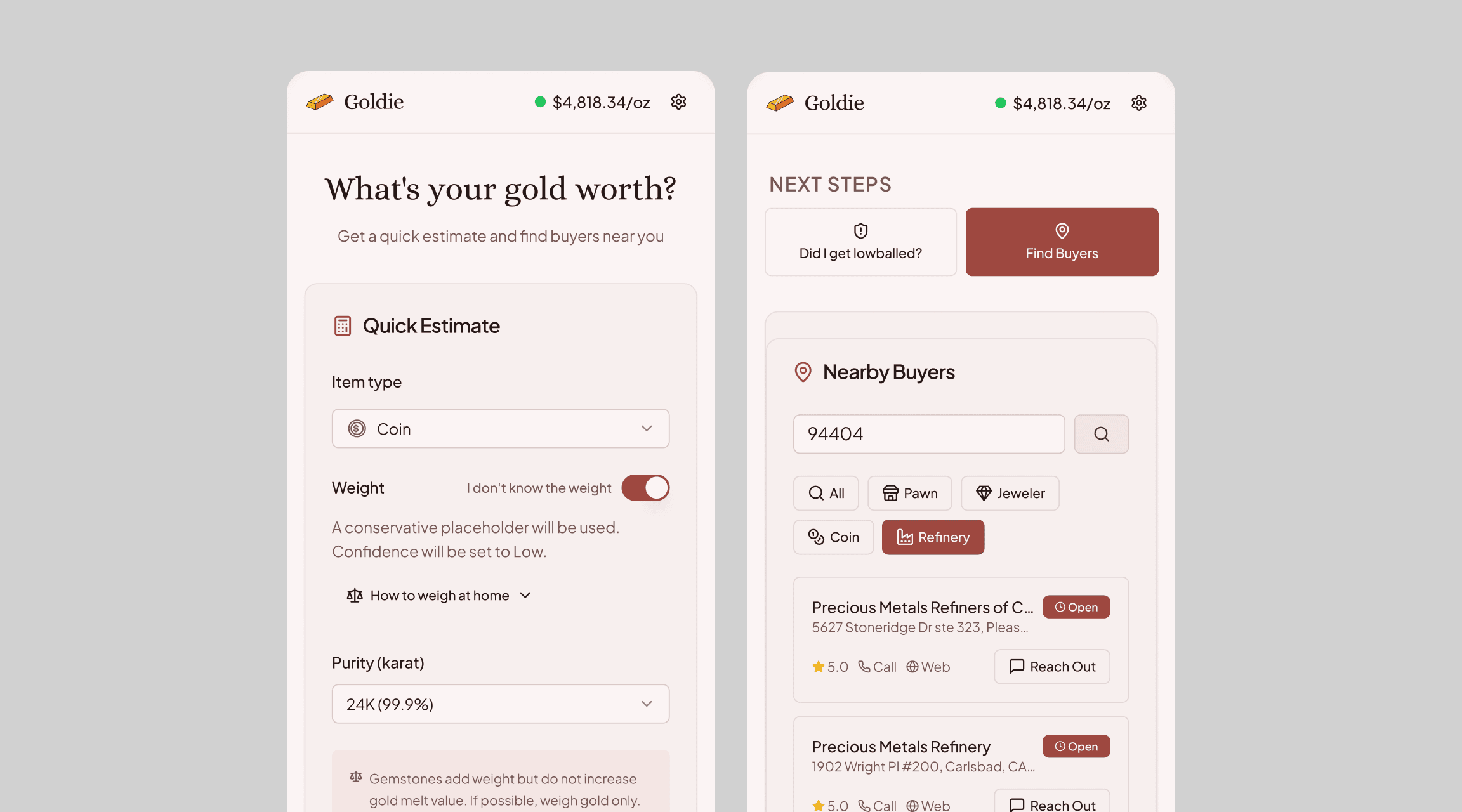
Shipped a live app with real-time gold price API, map integration, and AI-assisted flows. Went from zero to deployed in one session.

Problem

Research & backstory

Research & backstory

My family runs a jewelry shop in Taiwan. I spent my childhood watching people walk in wanting to sell gold, and almost every time, it was the same story: they had no clue what their piece was worth, no idea what questions to ask, and a quiet fear that they'd get ripped off.


Then gold doubled in 2025. Suddenly everyone with a drawer full of old jewelry was asking the same question those customers used to ask my parents.

My family runs a jewelry shop in Taiwan. I spent my childhood watching people walk in wanting to sell gold, and almost every time, it was the same story: they had no clue what their piece was worth, no idea what questions to ask, and a quiet fear that they'd get ripped off.


Then gold doubled in 2025. Suddenly everyone with a drawer full of old jewelry was asking the same question those customers used to ask my parents.

User painpoints

User painpoints

First-time sellers don't just need a price. The real problem has three layers:

Knowledge gap

"I don't know what 14k means or how weight affects price."

Trust gap

No baseline, so any offer feels suspicious.

Action gap

Even if I knew the value, I wouldn't know what to do next.

How might we make selling gold less intimidating for people doing it for the first time?

User Flow

One connected journey: describe your jewelry, get a realistic value range, compare buyer offers, and draft an outreach message, all in one flow.

Design decisions
Value estimation

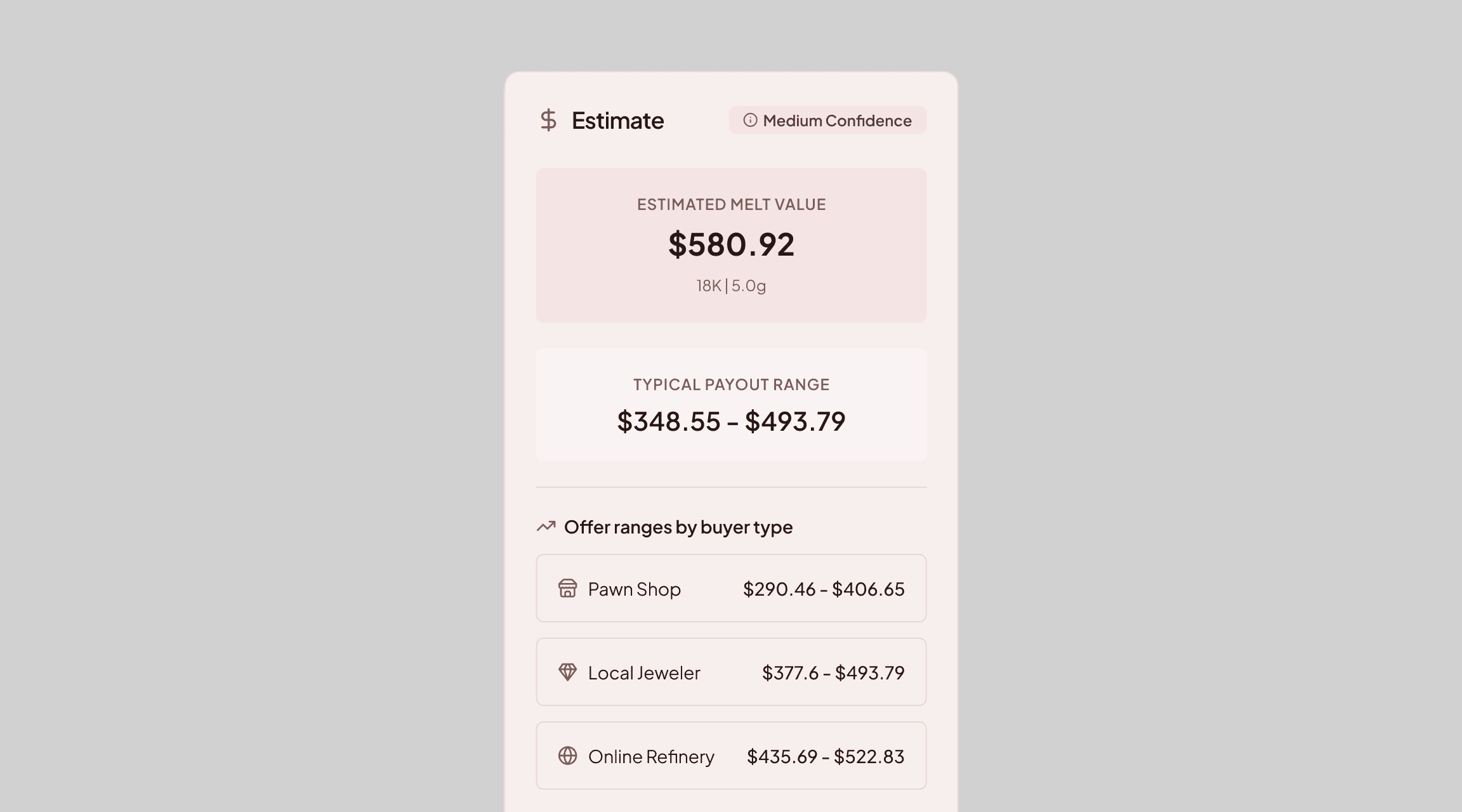
Show a range, not a number. Single estimates create false precision.

Decision support

Buyer comparison → Payout ranges by type so you know why offers differ.
AI Outreach

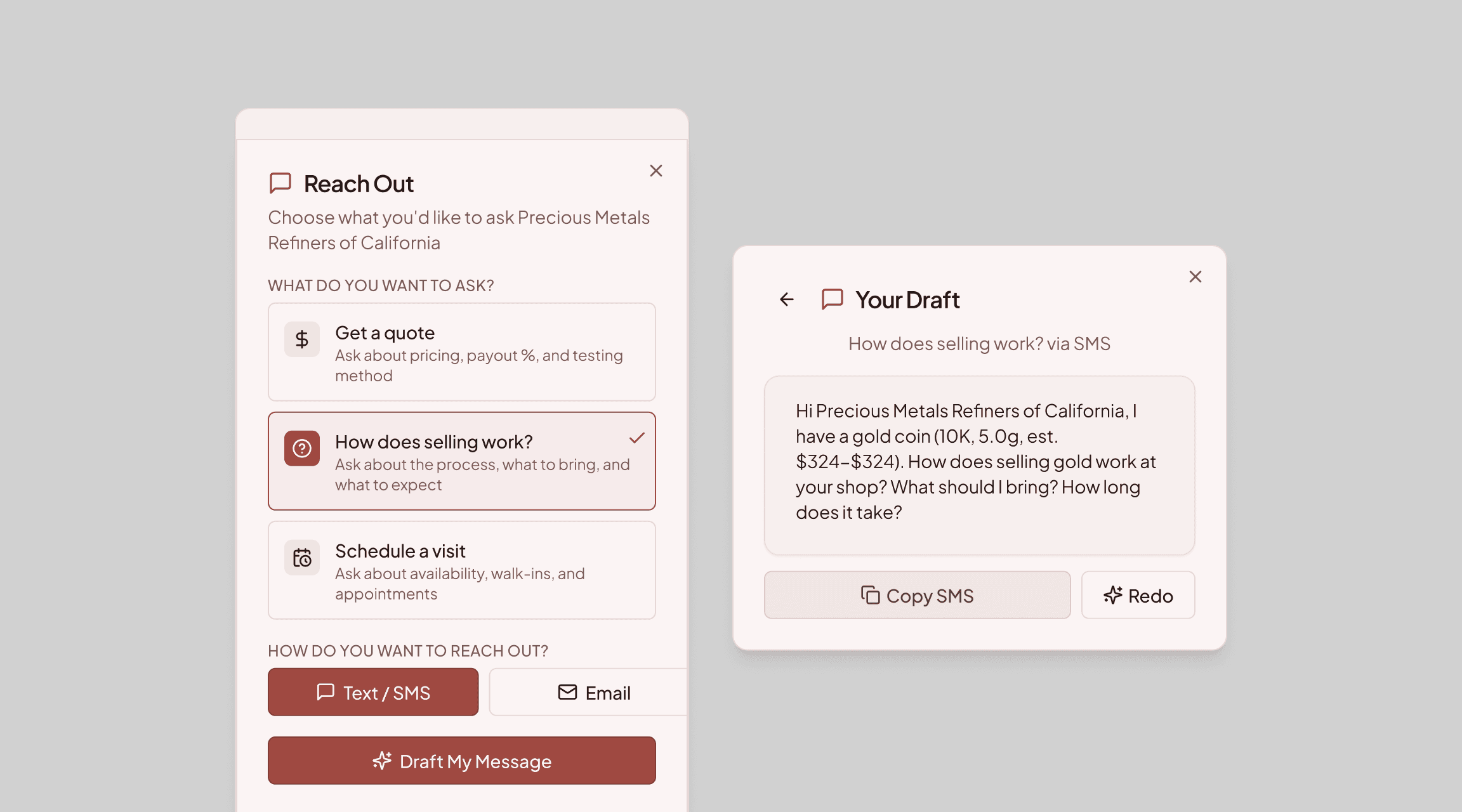
Goldie writes a ready-to-send message (SMS/email) with item details, estimate range, and questions to ask to help with decision making

Trade-offs

Navigation and discoverability

Navigation and discoverability

Consider tab-based navigation (Estimate / Check Offer / Find Buyers) over a single long scroll fold, so the full scope is visible upfront.

User testing

User testing

5-10 first-time sellers to test the product and observe where they hesitate.

Final Product

Next step

No production data yet but these are the metrics I would look at:

No production data yet but these are the metrics I would look at:

  1. Completion rate to see are people finishing the estimate flow or dropping off?
  2. Message generation rate to learn if users are taking action to see if decision-support UX works.

© 2026 Chiang (Michelle) Cheng, All Rights Reserved.

© 2026 Chiang (Michelle) Cheng, All Rights Reserved.

© 2026 Chiang (Michelle) Cheng, All Rights Reserved.